In 1995, corporate America faced a threat far more insidious than any economic recession: a little yellow icon of a card deck sitting right on the desktop. Windows 95 Solitaire is arguably the most expensive game ever made, if you calculate the billions of dollars in lost productivity it caused worldwide. It was the original desktop vice—the game you kept minimized, ready to aggressively alt-tab away the second your boss walked past your cubicle.
But what made this dead-simple, single-player card game so intensely addictive that companies literally tried to ban it from their hard drives?
The answer is a brilliant mixture of psychological design, historical timing, and a secret corporate agenda that changed how humanity interacts with machines forever.
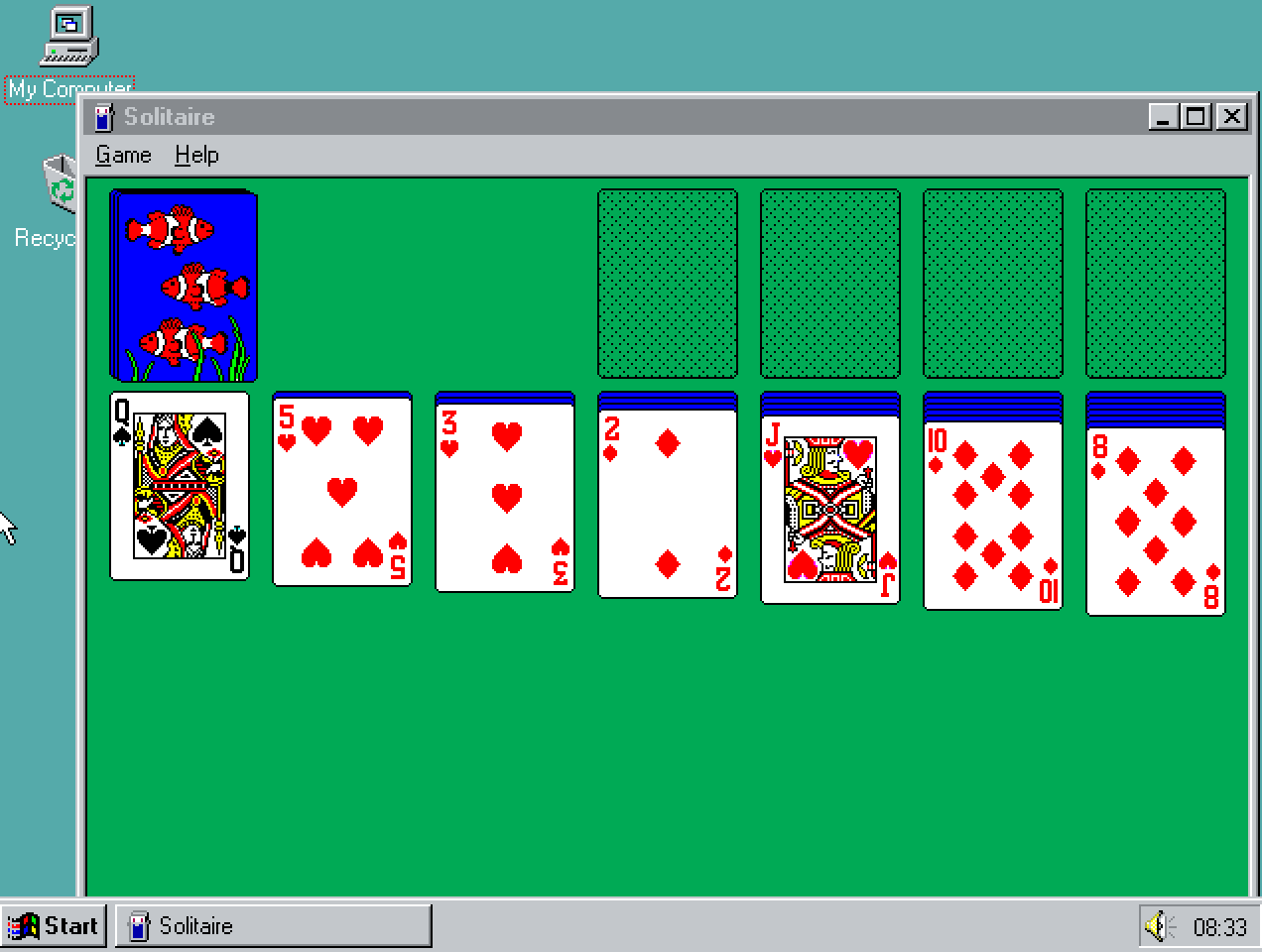
The Covert Mission: Teaching the Masses to Mouse
Believe it or not, Solitaire wasn’t put in Windows 95 just to be a game. It was a Trojan horse designed to solve Microsoft’s biggest hardware problem: teaching people how to use a computer mouse.
Windows 95 popularized computing for the masses, marking a massive evolution from its predecessor, Windows 3.0. Before this graphical user interface (GUI) revolution, consumer computing was entirely dictated by the Command Line Interface (CLI). If you wanted to run a program in MS-DOS, you typed a command. All you needed was a keyboard to navigate, write lines of code, and launch applications. The concept of moving a plastic brick across a foam pad to interact with a screen was completely foreign to most people.
When Microsoft shifted to a visual desktop layout, the mouse became the obvious and natural solution to navigate around. However, Microsoft faced a massive hurdle: the millions of professionals daily-driving computers were already deeply trained to use only a keyboard. They found the mouse clunky, imprecise, and frustrating.
Microsoft came up with a brilliant, stealthy solution: build a tutorial, but disguise it as a game. The true purpose of Windows 95 Solitaire wasn’t entertainment; it was muscle memory training. Stacking the cards taught users how to click and drag smoothly. Dropping a card onto a foundation pile trained them in precise coordinate dropping. Clearing the board required double-clicking. Without realizing it, users were mastering advanced user interface mechanics while playing a simple game of cards.
The "Futz Factor": Billions Drained in Lost Productivity
What Microsoft didn't anticipate was that this simple user-interface tutorial would mutate into a global obsession. Because it came pre-installed on almost every PC on earth, it blanketed schools, home studies, and corporate office spaces.
Throughout the 1990s, corporate executives watched in horror as their employees fell down the Solitaire rabbit hole. According to the technology historian Edward Tenner in his book Why Things Bite Back, a famous tongue-in-cheek workplace survey by SBT Accounting Systems coined the term "The PC Futz Factor" to describe the hours employees wasted wrestling with software or slacking off. The study estimated that corporate game-playing and desktop distractions were costing American businesses a staggering $10 billion annually in "stolen" company wages.
The anxiety over lost output was so high that it triggered a literal political crackdown:
- The Virginia Sweep (1995): Right as Windows 95 was taking over, Virginia Governor George Allen issued a strict executive order banning and deleting all games from all 103,000 state government computers to protect taxpayer funds.
- Fired by the Mayor (2006): The anti-Solitaire corporate culture peaked years later when New York City Mayor Michael Bloomberg famously spotted an office assistant named Edward Greenwood IX with Solitaire open on his screen. Bloomberg fired him on the spot, as reported by The Guardian, igniting a fierce national media debate about whether playing digital cards was a firing offense or just the modern equivalent of a coffee break.
The Solitaire Behavioral Loop
What makes Solitaire so uniquely compelling? It relies on a tight four-part psychological loop:
- The Micro-Flow State: Low cognitive entry barrier; can be picked up or dropped instantly.
- Variable Reward: Hidden cards under the stacks create a localized mystery box effect.
- High Win Rate Potential: Roughly 80% of Klondike deals are mathematically winnable, dangling victory close by.
- The Visual Payout: Cascading card animation fills the monitor, signaling complete closure.
Anatomy of the Dopamine Loop
The true magic of Solitaire lies in its frictionless barrier to entry. It requires just enough brainpower to distract you from real-world stress or a boring spreadsheet, but not enough to cause cognitive fatigue.
The psychological hook snaps into place the moment you start scanning the green felt. Looking for eligible placements from the stockpile hooks you instantly. Every time you flip a card and uncover a hidden option underneath, your brain experiences a miniature dopamine release. It mimics a low-stakes mystery box—you are constantly calculating whether to move a card from the pile to a column or up to the foundations, keeping your mind in a state of active, low-risk problem-solving.
And then, there is the legendary victory payoff. Winning a deal triggers the iconic cascading card animation, where the cards bounce across the screen, painting trailing patterns over the green canvas. This wasn't just visually satisfying; it was an accidental masterpiece of technical feedback. Early computer memory didn't clear previous frames efficiently, creating that stuttering trailing effect that felt like hitting a jackpot on a slot machine. Within this perfect loop, players completely lose track of time, promising themselves "just one more deal" until the sun comes up.
The Ancestor of the Modern Swipe
Solitaire’s success didn't just stop at teaching millions of 90s users how to operate a mechanical mouse. Its behavioral design laid the foundational blueprint for modern mobile gaming.
Look at how you interact with your phone today. The drag-and-drop mechanics, the double-taps to expand pictures, and the rhythmic swiping patterns we do with our fingers are the exact same kinetic inputs we practiced on Solitaire over thirty years ago. When mobile games like Candy Crush or casual card apps took over the app stores, they didn’t have to teach users how to play. The digital habits, the reward structures, and the physical gestures had already been perfected on a green digital desktop in 1995.
🂱 Ready to Test Your Card Skills?
Experience authentic Windows 95 card gaming directly in your browser with zero downloads, zero ads, and 100% free offline PWA play. Try our classic Klondike Solitaire, master the open cells in FreeCell Solitaire, or challenge friends in Multiplayer Solitaire with MSN Chat!