When Microsoft bundled FreeCell into Windows 95, it didn't just introduce a new card game to millions of office workers—it accidentally launched one of the earliest, most obsessive crowdsourcing projects in internet history.
Unlike Klondike Solitaire, where hidden cards leave your fate up to the luck of the draw, FreeCell is a game of "perfect information." Every card is dealt face-up from the very beginning. Because of this, players quickly realized that with enough skill, foresight, and logic, you could win almost every time.
But almost wasn't good enough for the early internet.
The Bold Claim That Started It All
The obsession started with a single, tantalizing sentence buried in the official Windows 95 FreeCell help file:
"It is believed (although not proven) that every game is winnable."
The Microsoft version of the game included exactly 32,000 distinct, numbered deals, generated by a 15-bit random number seed. You could type any number from 1 to 32,000 into the game's menu, and it would generate that exact layout every time.
For the growing community of dial-up internet users, the help file's claim was a direct challenge. Was it actually possible to beat all 32,000 games, or had Microsoft's random number generator accidentally created an unwinnable trap?
The Internet FreeCell Project
In the summer of 1994, a dedicated player named Dave Ring decided to find the answer. Using early internet forums and Usenet newsgroups, Ring organized The Internet FreeCell Project.
He recruited over 100 volunteer "solvers" from around the world and divided the 32,000 games into sequential chunks of 100. Volunteers would painstakingly play through their assigned blocks, sharing solutions for the difficult ones and passing the most stubborn layouts to the best players in the group. In a pre-cloud era, this was human parallel processing at its finest.
By October 1995, the project was complete. The crowd-sourced team of human brains successfully conquered 31,999 of the layouts.
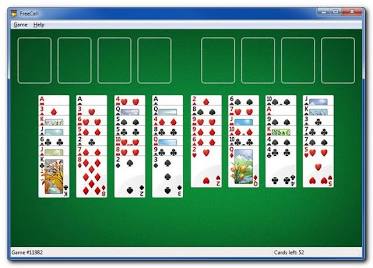
Only one game defied every single human attempt: Game #11982.
Anatomy of an Impossible Game
At first glance, Deal #11982 doesn't look completely broken. But as you attempt to make your opening moves, the mathematical trap quickly snaps shut.
If you look closely at the board, you can spot the structural nightmares that make it impossible:
- The Bottlenecks are Buried: All four Aces, as well as three of the Deuces (2s), are trapped in the bottom three rows of the tableau. You cannot start building your foundation piles without them.
- No "Easy" Columns: To empty a column in FreeCell, you need to move the cards above it into the free cells. In this specific deal, there is no column that can be cleared without needing at least three free cells right away—instantly crippling your movement multiplier.
- No Suit Synergy: There are no columns containing two Aces, or an Ace and a Two of the same suit, which would normally allow for quick, efficient stacking.
For years, people speculated that #11982 might be winnable and that humanity just hadn't found the right sequence of moves. Eventually, developers wrote brute-force solver algorithms to analyze the game. The computers checked every single possible sequence of legal moves, branching out into millions of variations.
The computers confirmed what Dave Ring's volunteers suspected: Deal #11982 is mathematically impossible to win. The cards are distributed in such a way that, no matter what you do, you will inevitably run out of legal moves and empty cells.
The Legacy of the Unsolvable Deal
Microsoft developers actually knew that impossible games could exist. As an internal joke, they programmed two secret "Easter egg" games into the software—deals -1 and -2. If you load these up, the cards are deliberately arranged in a descending sequence that guarantees you will be stuck after exactly four moves.
But #11982 wasn't a joke; it was a pure statistical anomaly.
Years later, when Microsoft updated FreeCell for Windows XP, they expanded the game pool from 32,000 to 1,000,000 numbered deals. Once again, computer solvers analyzed the entire expanded set. Out of the first one million games, only eight were found to be impossible (including 146,692, 186,216, and our old friend 11,982).
Today, Deal #11982 holds a legendary status in the retro-gaming community. It stands as a fascinating artifact of the 90s—a time when a simple card game could unite people across the globe to solve a mathematical mystery, proving that sometimes, the machine really does deal an unbeatable hand.
Think you can beat the unbeatable?
Try your luck with game Deal #11982
Play Deal #11982🂱 Ready to Test Your Card Skills?
Experience authentic Windows 95 card gaming directly in your browser with zero downloads, zero ads, and 100% free offline PWA play. Try our classic Klondike Solitaire, master the open cells in FreeCell Solitaire, or challenge friends in Multiplayer Solitaire with MSN Chat!