Close your eyes and let your mind drift back to a random Tuesday afternoon in 2004. You’ve just dropped your backpack by the front door, kicked off your shoes, and sprinted straight to the family PC. You flip on the heavy monitor, listen to the low, rhythmic hum of the computer tower spinning up, and click that iconic icon of two little blue-and-green figures. You wait, holding your breath, as they rotate around each other in a digital dance.
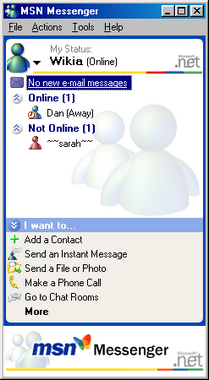
Suddenly—ping. You’re in.
Long before algorithms dictated what we saw, before endless feeds hijacked our attention spans, and before "likes" became a metric of self-worth, there was MSN Messenger. It wasn’t just a chat client; it was a cultural phenomenon. For a generation navigating the awkward waters of middle and high school, MSN was the definitive training ground for modern digital socialization. It gave us a raw, intensely personal, and beautifully chaotic canvas to build our very first online identities.
The Symphony of Notification Sounds
To anyone who grew up in the early 2000s, MSN Messenger didn't just look a certain way—it sounded a certain way. It was an era where soundscapes carried profound emotional weight. The most anticipated sound of the day was the soft, mechanical chime of a digital door opening. That subtle audio cue signaled that your best friend, your neighborhood crew, or—most importantly—your crush had finally logged on. Instantly, your brain fired off a shot of pure excitement. What followed was a rhythmic tapestry of typewriter clicks and crisp alerts as message bubbles popped into existence.
But no audio feature holds quite as much notoriety as the Nudge.
If a friend was taking more than thirty seconds to reply to your incredibly urgent message, you didn’t just sit there. You hit the Nudge button. Instantly, their entire chat window would violently rattle across their desktop accompanied by a loud, aggressive buzz sound that could be heard three rooms away. It was the ultimate, impatient digital demand for attention—a tool weaponized to break through teenage procrastination.
The Passive-Aggressive Social Dance
Because we didn’t have timelines to post on, we had to get creative with how we communicated our moods. MSN etiquette quickly became a highly sophisticated, passive-aggressive art form.
Take, for instance, the legendary "Flash-Sign-In." If you wanted a specific person to notice you were online, you didn’t dare message them first—that was far too direct. Instead, you would rapidly sign out and sign back in three or four times in a row. This intentional glitch spammed the bottom-right corner of their monitor with a cascading stack of your login notifications. It was the digital equivalent of waving your arms in a crowded room.
Then came the Custom Subtext Status. MSN allowed you to put a personal handle next to your screen name, which we promptly turned into an emotional battlefield. We became master cryptographers, using angst-ridden lyrics from bands like Linkin Park, Blink-182, Evanescence, or Dashboard Confessional to broadcast our deep teenage feelings without having to say a single word.
"I've tried so hard and got so far... (BRB getting dinner) ~*~"
If you were mad at a friend, you took them out of your status. If you were feeling mysterious, you utilized the ultimate power move: "Appear Offline." Sitting in invisible mode allowed you to silently spy on who was talking to whom, or deliberately avoid that one annoying classmate from biology while remaining perfectly available to your inner circle.
Visual Chaos: Ruining Readability for the Flex
When Microsoft granted us the power to customize our chat windows, we didn't just personalize them; we completely ruined them.
The introduction of custom emoticons quickly devolved into absolute visual anarchy. MSN allowed you to assign any animated shortcut to a specific word or letter. Within weeks, simple text conversations became completely unreadable. A message like "Hey, want to go to the mall?" would render as a blinding parade of flashing, rotating, low-resolution GIFs of dancing bananas, spinning hearts, and glittering text. It took ten minutes of intense squinting just to decipher if your friends were inviting you out or casting a spell on you.
| Classic MSN Features | Their True Social Purpose |
|---|---|
| The Nudge | Violent screen-shaking used to punish slow replies. |
| "What I'm Listening To" | Integrating Windows Media Player to prove how deep your music taste was. |
| Winks | Massive, screen-blocking animations (like the knocking hand) sent to disrupt chats. |
| Custom Emoticons | Turning regular text into an unreadable mess of animated GIFs. |
We also used our computers to curate our coolness through the "What I'm Listening To" feature. By integrating Winamp or Windows Media Player, your status would automatically update with the track you were playing. We would spend hours meticulously curating our playlists, agonizing over whether playing a specific indie track would make us look sufficiently cultured to the rest of our contact list.
The Bridge to the Modern World
MSN Messenger eventually faded into the background, eclipsed by the arrival of Facebook, smartphones, and always-on mobile apps. But its DNA is baked into every single piece of software we use today.
When you see the little animated "typing..." bubbles on iMessage or WhatsApp, you are looking at a feature perfected by MSN. The modern Instagram Story or Slack status is just a prettier version of the 250-character text handle we used to vent our frustrations twenty years ago.
But more than the features, what makes us look back on MSN Messenger with such profound warmth is the boundary it represented. It belonged to an era of "intentional internet." To talk to your friends, you had to physically sit at a desk, log in, and dedicate your time to a conversation. You only talked to people you actually knew in real life. It was a closed, safe, and wildly expressive playground—a golden era of connection that taught us how to be ourselves online, one blinking text color at a time.
The Modern Revival: Solitaire Online and the Return of the MSN Era
For years, these memories of green digital felt and spinning MSN icons lived only in the archives of our minds. But nostalgia is a powerful force, and it was only a matter of time before someone built a time machine. Enter Solitaire Online, a platform that doesn’t just let you play the classic card game—it completely resurrects the social ecosystem that defined the turn of the millennium.
Imagine launching a game of Klondike, FreeCell, or Spider, and instead of playing in isolated silence, a familiar desktop environment materializes on your screen. Solitaire Online has accomplished the ultimate retro crossover by embedding a fully functioning, built-in messenger right into the website interface.
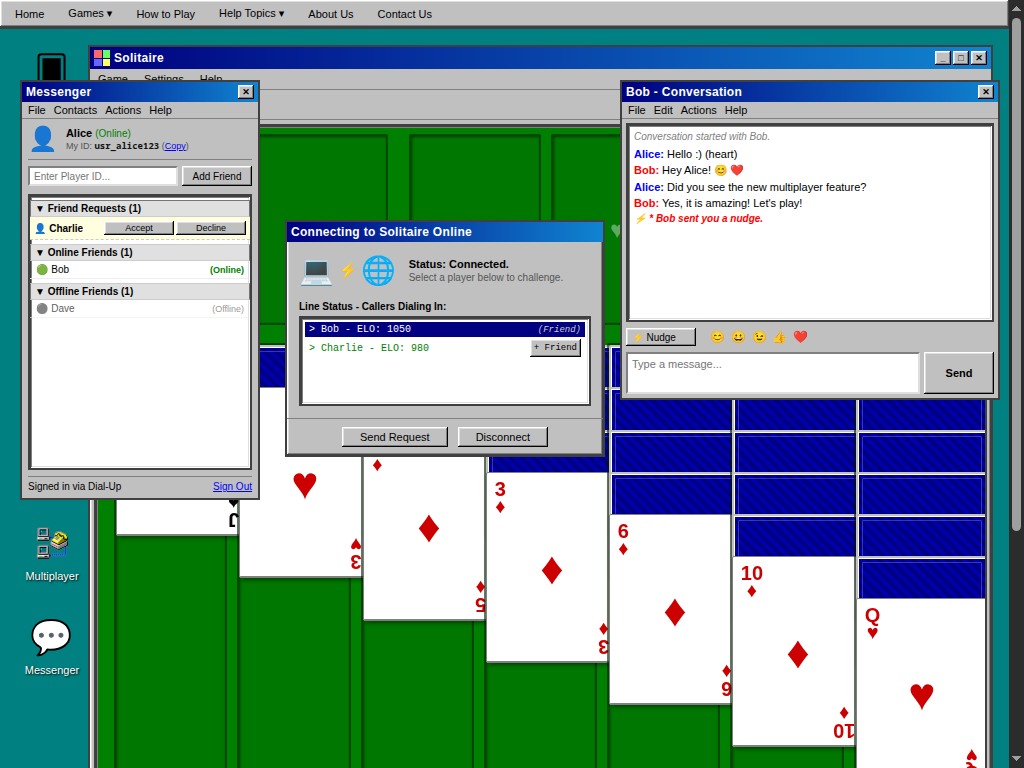
This isn’t just a basic text box; it is a meticulously crafted homage packed with the exact features that made the early 2000s internet so magical:
- The Return of the Global Buddy List: As you play variants like Draw 1 or Draw 3 against people worldwide, you can instantly add your opponents directly to your permanent friend list to chat with them later.
- The Nostalgic Audio & Visual Toolkit: The interface brings back the features we craved, allowing you to interact using classic custom statuses, text handles, and those iconic alert soundscapes.
- Frictionless Socializing: It recaptures the "intentional internet" feel. You can keep your card game running on one side of the screen while managing your chat roster on the other, flawlessly recreating the 90s multitasking experience.
By marrying the world’s most addictive user-interface tutorial with the golden era of peer-to-peer chatting, platforms like this prove that the design language of 1995 wasn't a passing phase. It was a peak era of human connection—and it’s only a single click away.
🂱 Ready to Test Your Card Skills?
Experience authentic Windows 95 card gaming directly in your browser with zero downloads, zero ads, and 100% free offline PWA play. Try our classic Klondike Solitaire, master the open cells in FreeCell Solitaire, or challenge friends in Multiplayer Solitaire with MSN Chat!