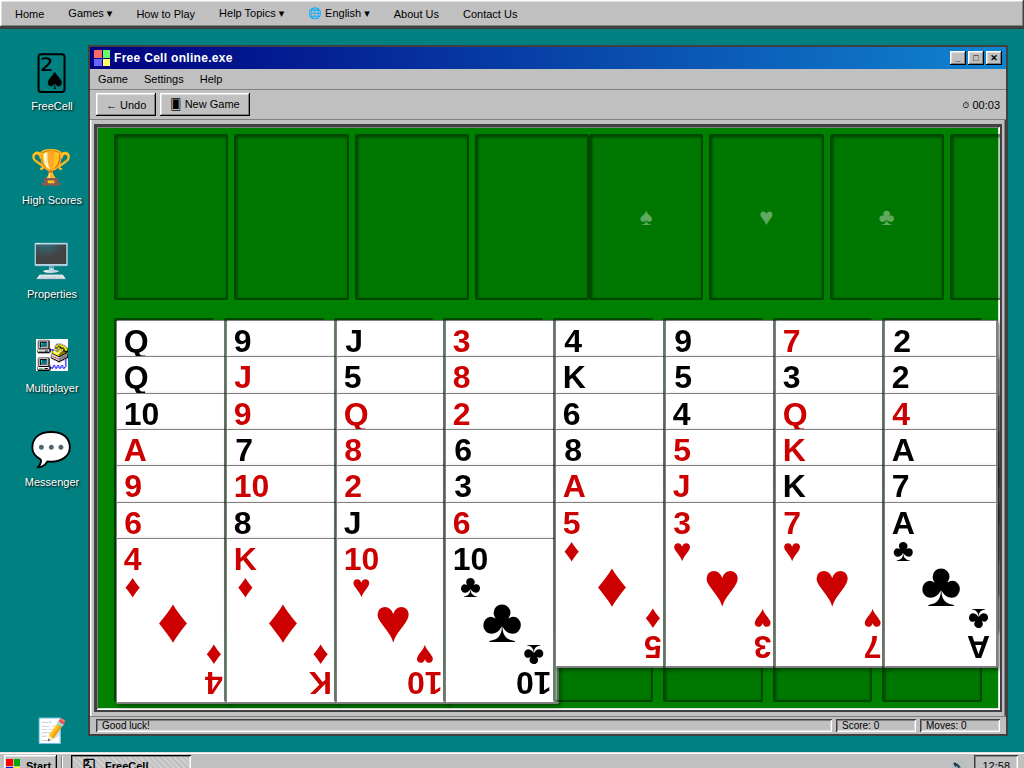
Unlike standard Klondike Solitaire, where a bad draw or a buried card can end your game before it even begins, FreeCell is a game of pure skill, logic, and foresight. Because all 52 cards are dealt face-up right from the start, there are no hidden surprises.
In fact, mathematicians and computer scientists have extensively analyzed the game. When Microsoft included the original 32,000 numbered deals in early versions of Windows, players discovered that exactly one game (the infamous Deal #11982) was unsolvable. That means 99.99% of all standard FreeCell deals can be beaten.
If you frequently find yourself getting stuck with nowhere to move, you aren't fighting bad luck—you just need a better system. Whether you are looking to kill time during a break or want to play freecell online to sharpen your cognitive skills, mastering the underlying mechanics transforms the game from a frustrating roadblock into a highly satisfying puzzle.
Here is the ultimate, expanded strategic breakdown to help you win almost every single time you load up freecell online free.
The Math of Movement: Understanding Your Limits
Before moving a single card, you must understand the invisible math that governs FreeCell. The game only allows you to move one card at a time. When you drag a "stack" of four cards across the board, the computer is rapidly using your empty free cells to dismantle and rebuild that stack for you.
The maximum number of cards you can move in a single stack is strictly dictated by a mathematical formula: (1 + F) × 2E, where F is the number of empty free cells and E is the number of empty tableau columns.
In plain terms:
- If you have 4 empty free cells and 0 empty columns, you can move 5 cards.
- If you have 0 empty free cells, you can only move 1 card at a time.
- Empty columns are multipliers. Having just one empty column doubles your movement capacity.
Understanding this math reveals why your free cells and empty columns are your most valuable resources.
The Golden Rules of Mid-Game Strategy
To boost your win rate to that magical 99.9% threshold, internalize these four foundational tactics:
1. Guard Your Free Cells With Your Life
The most common mistake new players make is immediately dumping cards into the top-left free cells just to access the cards underneath them. The golden rule of FreeCell is to keep your free cells empty for as long as humanly possible.
Think of your free cells as a temporary transit system, not a permanent parking lot. Every occupied cell slashes your movement capacity across the rest of the board. Only move a card to a free cell if it directly results in freeing up an Ace, moving a card to the foundation, or clearing an entire column.
2. Hunt Down the Aces and Deuces Early
Your first priority in any game is to locate the four Aces and the four Deuces. Because the top-right foundation piles must be built starting with the Aces, these specific cards are the bottlenecks of the entire game. If an Ace of Spades is buried at the top of a deep, eight-card column, your entire opening and mid-game strategy must revolve around carefully dismantling that specific column to extract it.
3. Build Safe, Continuous Columns
When moving cards between the eight main tableau columns, prioritize building sequences from the highest possible values down to the lowest. For example, placing a Black 9 on a Red 10 is a "safe" build. Conversely, if you immediately start stacking low cards (like putting a Red 4 on a Black 5), you create a short, dead-end column that is incredibly difficult to move later. Focus your early game on building long, alternating sequences starting from Kings, Queens, and Jacks.
4. The "Foundation Delay" Trap
It is tempting to immediately send every eligible card up to the foundation piles the second they become available. Resist this urge. Sometimes, you need a specific card to remain in the main play area to act as a placeholder. For example, if you send your Red 6 to the foundation, you will have nowhere to place your Black 5 to uncover the cards beneath it. Only send cards up if you are absolutely sure you won't need them to hold a sequence together.
The Step-by-Step Opening Move Sequence
A successful FreeCell game is often decided in the first five moves. Staring at 52 face-up cards can be overwhelming, so use this strict sequence to evaluate the board before you drag your first card:
1. Scan for Immediate Aces: Always clear the absolute bottlenecks first. Before touching any other cards, scan the bottom row of all eight columns. If any Aces are completely exposed, click them up to the foundation immediately.
2. Trace the Buried Deuces: Identify your secondary blockers. Find the Aces and Deuces that are buried under the longest stacks. Trace your finger up the column to identify exactly which cards are blocking them, and formulate a mental plan to move those specific blockers.
3. Execute 'Free' Consolidations: Move cards without using free cells. Look for cards you can stack on top of each other within the main tableau without burning any of your four free cells (e.g., moving an exposed Red 7 onto an exposed Black 8). Do this to shorten columns safely.
4. Target an Empty Column: Secure your movement multiplier. Find the shortest column on the board that does not contain a King. Dedicate your first few free cell placements to completely emptying this column. Once empty, use it to park a long sequence starting with a King.
By mapping your strategy around empty columns rather than just blindly moving cards, you'll find that even the most tangled, intimidating deals unravel beautifully.